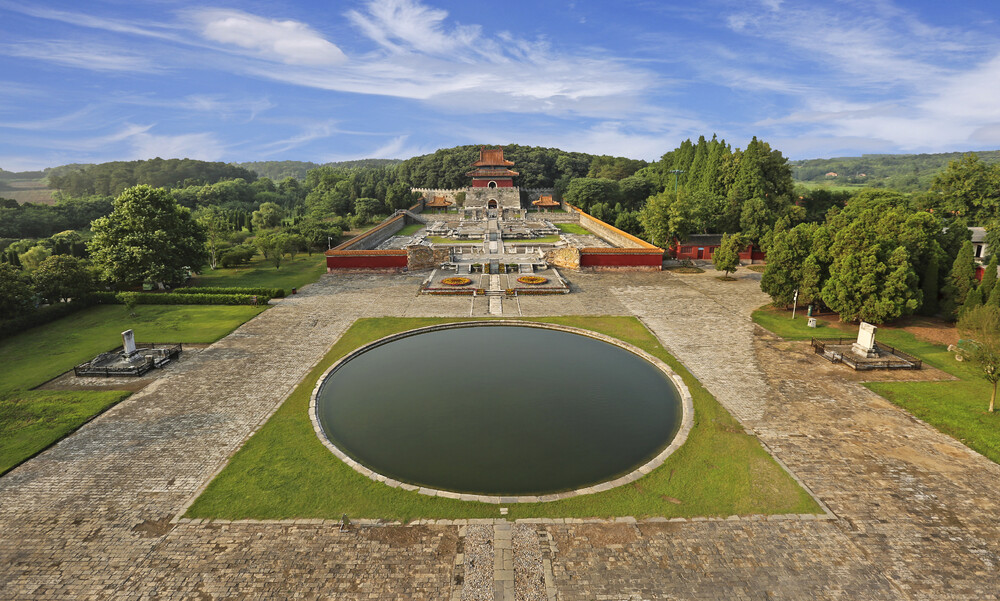
Brief Description
It represents the addition of three Imperial Tombs of the Qing Dynasty in Liaoning to the Ming tombs inscribed in 2000 and 2003. The Three Imperial Tombs of the Qing Dynasty in Liaoning Province include the Yongling ...
Outstanding Universal Value - Brief Synthesis
The Imperial Tombs of the Ming and Qing Dynasties were built between 1368 and 1915 AD in Beijing Municipality, Hebei Province, Hubei Province, Jiangsu Province and Liaoning Province of China. They comprise of the Xianling Tombs of the Ming Dynasty and the Eastern and Western Qing Tombs inscribed on the World Heritage List in 2000; the Xiaoling Tomb of the Ming Dynasty and the Ming Tombs in Beijing added to the inscription in 2003, and the Three Imperial Tombs of Shenyang, Liaoning Province (Yongling Tomb, Fuling Tomb, and Zhaoling Tomb, all of the Qing Dynasty) added in 2004.
The Ming and Qing imperial tombs are located in topographical settings carefully chosen according to principles of geomancy (Fengshui) and comprise numerous buildings of traditional architectural design and decoration. The tombs and buildings are laid out according to Chinese hierarchical rules and incorporate sacred ways lined with stone monuments and sculptures designed to accommodate ongoing royal ceremonies as well as the passage of the spirits of the dead. They illustrate the great importance attached by the Ming and Qing rulers over five centuries to the building of imposing mausolea, reflecting not only the general belief in an afterlife but also an affirmation of authority.
The tomb of the first Ming Emperor, the Xiaoling Tomb broke with the past and established the basic design for those that followed in Beijing, and also the Xianling Tomb of the Ming Dynasty in Zhongxiang, the Western Qing Tombs and the Eastern Qing Tombs. The Three Imperial Tombs of the Qing Dynasty in Liaoning Province (Yongling Tomb, Fuling Tomb, and Zhaoling Tomb) were all built in the 17th century for the founding emperors of the Qing Dynasty and their ancestors, integrating the tradition inherited from previous dynasties with new features from the Manchu civilization.
The Imperial Tombs of the Ming and Qing Dynasties are masterpieces of human creative genius by reason of their organic integration into nature, and a unique testimony to the cultural and architectural traditions of the last two feudal dynasties (Ming and Qing) in the history of China between the 14th and 20th centuries. They are fine works combining the architectural arts of the Han and Manchu civilizations. Their siting, planning and design reflect both the philosophical idea of “harmony between man and nature” according to Fengshui principles and the rules of social hierarchy, and illustrate the conception of the world and power prevalent in the later period of the ancient society of China.