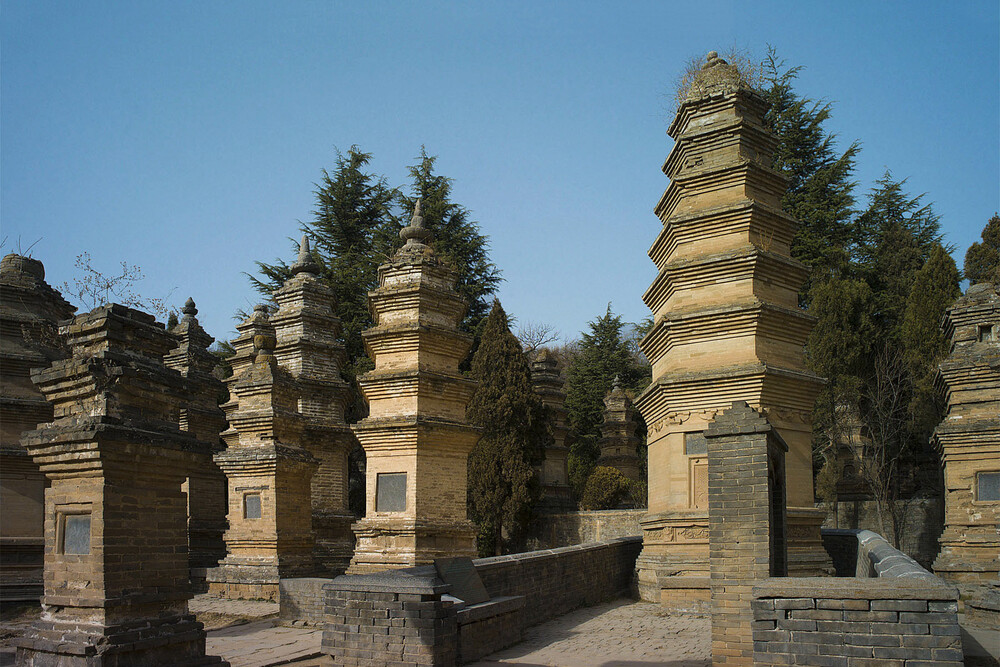
Brief Description
Mount Songshang is considered to be the central sacred mountain of China. At the foot of this 1500 metre high mountain, close to the city of Dengfeng in Henan province and spread over a 40 square-kilometre circle, ...
Outstanding Universal Value - Brief Synthesis
For many centuries Dengfeng, one of the early capitals of China whose precise location is unknown, but whose name is now associated with an area to the south of Mount Shaoshi and Mount Taishi, two peaks of Mount Songshan, came to be associated with the concept of the centre of heaven and earth – the only point where astronomical observations were considered to be accurate. The natural attribute of the centre of heaven and earth was seen to be Mount Songshan and worship of Mount Songshan was used by the Emperors as a way of reinforcing their power.
The three ideas do therefore converge to some extent: the centre of heaven and earth in astronomical terms is used as a propitious place for a capital of terrestrial power, and Mount Songshan as the natural symbol of the centre of heaven and earth is used as the focus for sacred rituals that reinforce that earthly power. The buildings that clustered around Dengfeng were of the highest architectural standards when built and many were commissioned by Emperors. They thus reinforced the influence of the Dengfeng area.
Some of the sites in the nominated area relate closely to the mountain (Zhongyue Temple, Taishi Que and Shaoshi Que); the Observatory is very clearly associated with the astronomical observations made at the centre of heaven and earth, while the remainder of the buildings were built in the area perceived to be the centre of heaven and earth – for the status that this conferred.