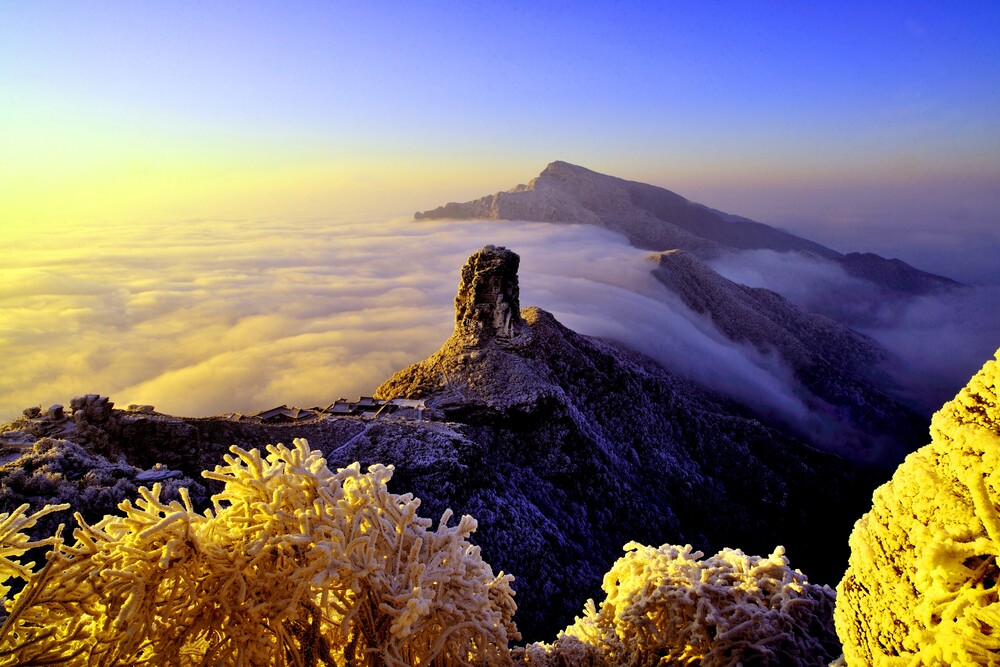
Brief Description
Located within the Wuling mountain range in Guizhou Province (south-west China), Fanjingshan ranges in altitude between 500 metres and 2,570 metres above sea level, favouring highly diverse types of vegetation and ...
Outstanding Universal Value - Brief Synthesis
The Fanjingshan World Heritage property is located in South-West China, covering a total area of 40,275 ha, fully enclosed by a buffer zone of 37,239 ha. Fanjingshan is located in a monsoonal climatic context and is an important source of water for the surrounding landscapes and beyond, with some 20 rivers and streams feeding the Wujiang and Yuanjiang River systems, both of which ultimately drain into the Yangtze River.
The property consists of two parts, namely the Jian Nan subtropical evergreen forests ecoregion (64%) and the Guizhou Plateau broadleaf and mixed forests ecoregion (36%). The highest peak, Mt Fenghuangshan, has an elevation of 2,570 m above sea level (masl) and the property covers and an altitudinal range of more than 2,000 m. The resulting vertical stratification of vegetation falls within three major altitudinal vegetation zones: evergreen broadleaf forest (<1,300 masl), mixed evergreen and deciduous broadleaf forest (1,300-2,200 masl) and mixed deciduous broadleaf and conifer and scrub forest (>2,200 masl).
Fanjingshan is an island of metamorphic rock in a sea of karst and is home to many ancient and relict plant and animal species which originated in the Tertiary period, between 65 million and 2 million years ago. The property’s geologic and climatic characteristics have shaped its flora which behaves as if it were on an island. This has led to a high degree of endemism, with a total of 46 locally endemic plant species, 4 endemic vertebrate species and 245 endemic invertebrate species. The most prominent endemic species are Fanjingshan Fir (Abies fanjingshanensis - EN) and Guizhou Snub-nosed Monkey (Rhinopithecus brelichi - EN), both of which are entirely restricted to the property. Three species of Fagus (F. longipetiolata, F. lucida, and F. engleriana) are the dominant species of what is understood to be the largest primary beech forest in the subtropical region.
A total of 3,724 plant species have been recorded in the property, an impressive 13% of China’s total flora. The property is characterized by an exceptionally high richness in bryophytes as well as one of the distribution centres for gymnosperms in China. The diversity of invertebrates is also very high with 2,317 species. A total of 450 vertebrate species are found inside the property. Fanjingshan being the only habitat in the world for Fanjingshan Fir and Guizhou Snub-nosed Monkey, as well as 64 plant and 38 animal species that are listed as globally threatened, including the tree Bretschneidera sinensis (EN), Chinese Giant Salamander (Andrias davidianus - CR), Forest Musk Deer (Moschus berezovskii - EN), Reeves’s Pheasant (Syrmaticus reevesii - VU), and Asiatic Black Bear (Ursus thibetanus - VU).