Brief Description
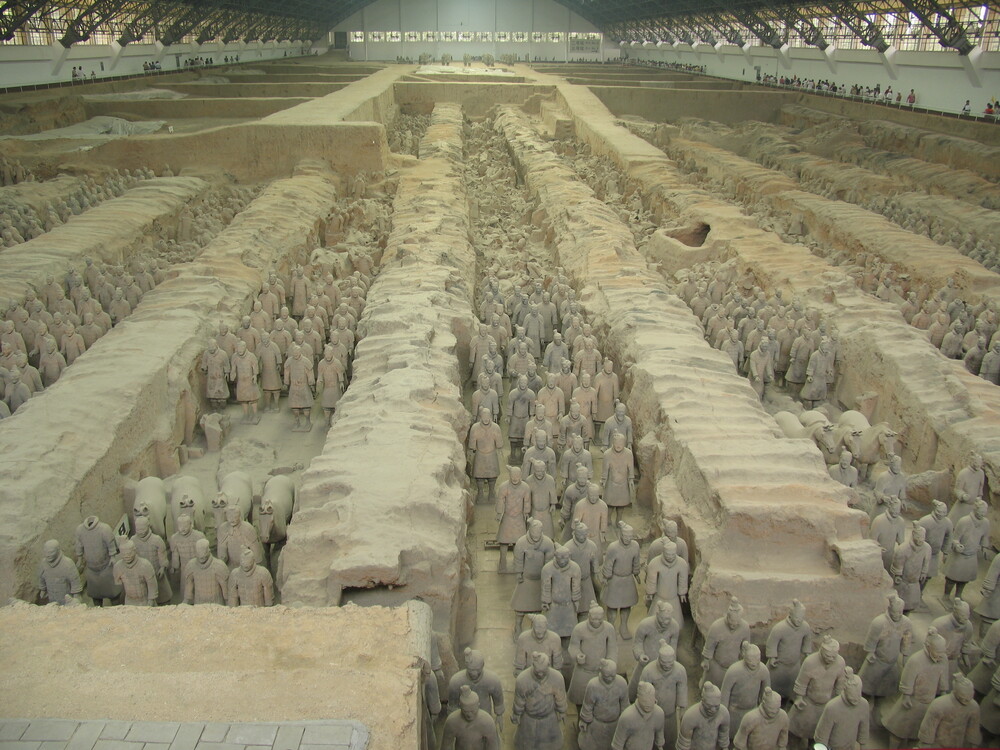
No doubt thousands of statues still remain to be unearthed at this archaeological site, which was not discovered until 1974. Qin (d. 210 B.C.), the first unifier of China, is buried, surrounded by the famous ...
Outstanding Universal Value - Brief Synthesis
Located at the northern foot of Lishan Mountain, 35 kilometers northeast of Xi'an, Shaanxi Province, Qinshihuang Mausoleum is the tomb of Emperor Qinshihuang, founder of the first unified empire in Chinese history during the 3rd century BCE. Begun in 246 BCE the grave mound survives to a height of 51.3 meters within a rectangular, double-walled enclosure oriented north-south. Nearly 200 accompanying pits containing thousands of life-size terra cotta soldiers, terra cotta horses and bronze chariots and weapons - a world-renowned discovery - together with burial tombs and architectural remains total over 600 sites within the property area of 56.25 square kilometers. According to the historian Sima Qian (c. 145-95 BCE), workers from every province of the Empire toiled unceasingly until the death of the Emperor in 210 in order to construct a subterranean city within a gigantic mound.
As the tomb of the first emperor who unified the country, it is the largest in Chinese history, with a unique standard and layout, and a large number of exquisite funeral objects. It testifies to the founding of the first unified empire- the Qin Dynasty, which during the 3rd BCE, wielded unprecedented political, military and economic power and advanced the social, cultural and artistic level of the empire.